Instructor Interview: Gregory Carl Banks Jr.
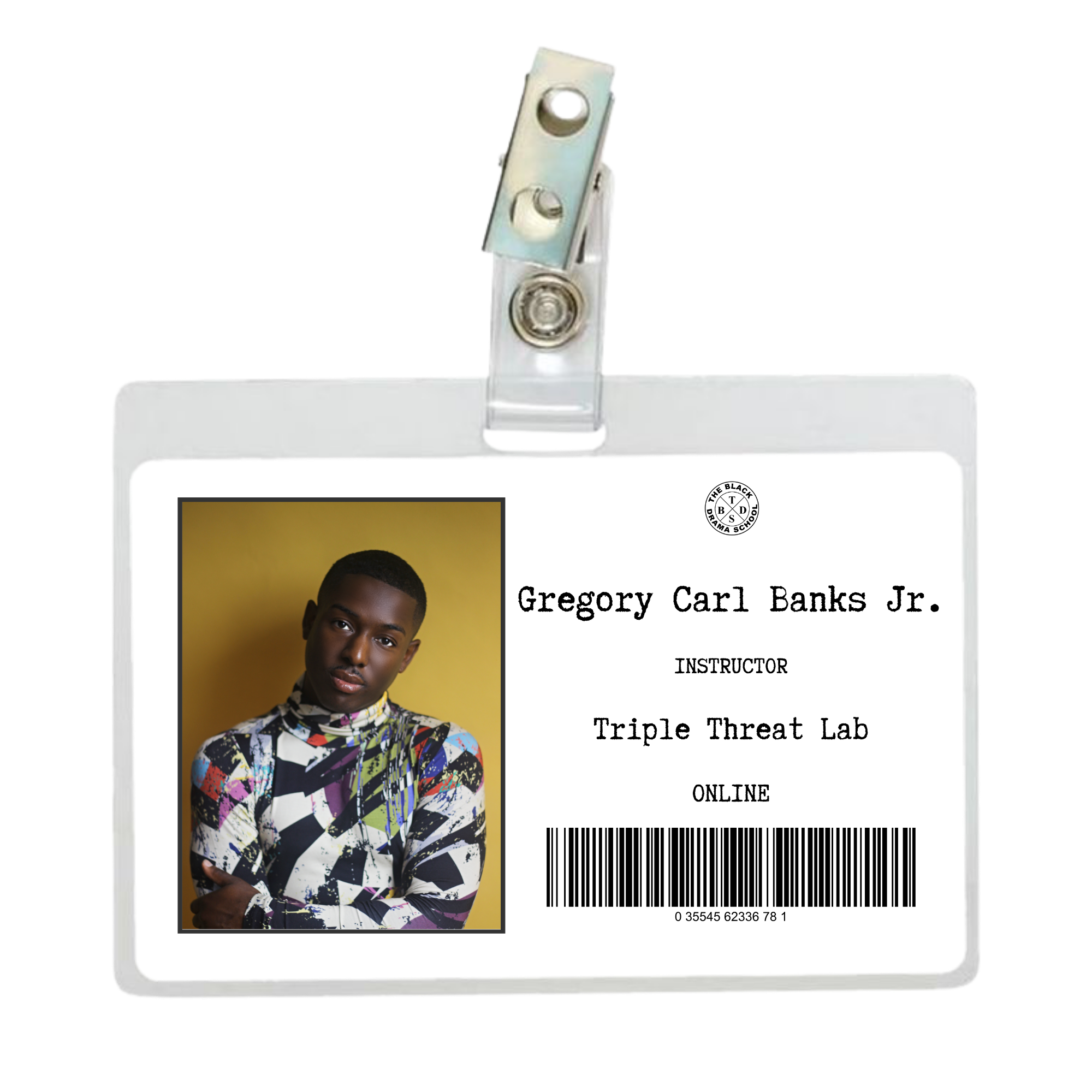
Meet Gregory(he/they)
This interview was conducted July 24, 2026
Korinn Annette Jefferies: Tell me how you got started doing theater.
Gregory Carl Banks Jr.: I got started doing theater when I was about 8 years old. My parents were looking for a cheap summer option for their children, and they came across a theater camp.. And from there, um, we went to this theater camp, but I was bitten by the theater bug. And, um, for me, it became my daily requirement that I needed to go to theater camp every summer and so my parents afforded me that ability. And maybe 3 years into finding this theater bug, my dad offered to take me to an audition for The Lion King on Broadway. I'm from New Jersey, so auditioning for Broadway shows and going to see Broadway shows was very accessible. And so I decided to take that leap as a 10 year old. And I made it through years' worth of auditions for The Lion King. And ultimately, I didn't get cast as the role of ‘Simba’ because I was too tall after auditioning for that long. And um as a kid, I made it my mission that day— I told myself after I wiped the tears and let it go—I told myself that day, I didn't care what I had to do, but I was gonna make sure that I played ‘Older Simba.’ And so, I have been on a life mission, a passion project, to play this one role. But also, it has opened my eyes to what I was brought on this earth to do, and it is to create art, to create theatre and create something that is larger than life for everyone to enjoy. And, um, I'm very, very proud, that I have found that purpose from something that happened in my childhood that could have ultimately made me stop, but it made me stronger. It made me know that there were ups and downs, there were no’s, and that, um, you are in control of your narrative.
“… it has opened my eyes to what I was brought on this earth to do, and it is to create art, to create theatre and create something that is larger than life for everyone to enjoy.”
KAJ: I love that. And you have a ‘Simba’ tattoo, right?
GCBJ: I do have a ‘Simba’ tattoo, and that is my marker to myself that is my memory to say, this is something that I did. And my life plan is that when I finally play Simba on Broadway, that's when I will put the mane on Simba. It's the same tattoo that Rafiki does on the tree. And so when Rafiki finds out that Simba is alive, she puts the mane on Simba, and so that is what I'm gonna do.
KAJ: So I think it's safe to assume that performing or being on stage acting is your favorite role in the theater.
GCBJ: Uh, yes, definitely it is my favorite role in the theater to be on the stage doing the things, but I have also found so much love in creating. I think that it keeps the respect for what everyone does if you step outside of the limelight of the stage, if you step out of the spotlight, then you put the spotlight on someone else. And you learn how to use that spotlight. And I'm saying that as a technical theater term, like, I think that I was afforded the opportunity at Howard. I was on the lighting team at Howard, and we had to become the tech team for the show, and it makes you grow this different appreciation for theater.
Last year I was an Associate Choreographer for a production of Beautiful, um, the Carole King musical, and it also reignited that love that I have for theater that I have for creating. It was my 1st time being in that type of administrative role on the other side of the table for theater, and I was very nervous. I was very excited. And it wasn't until I noticed that the cast gravitated to me when there were ruptures or things not going right when there was miscommunication with the director—I was that person for the cast that everyone trusted, everyone believed in, and like, I could not believe it, but I had to believe it because I had these people depending on me. And there's nothing like that feeling when you know that you've had a hand in creating something for people to shine in. And so I think that that is what has driven me to ultimately want to begin choreographing, begin, um, pulling that extra X factor out of young artists or out of people that desire a life of performing.
KAJ: Could you tell us a little bit more about like your background with dance and music as well?
GCBJ: Yes, so, um, it's funny. I was actually telling someone yesterday that I grew up playing football, right? So I went to theater camp every summer, but I also played football. So, like, I was very much a Troy Bolton. And from there, um, once I decided that I wanted to go to college for musical theater, I realized that there was a lot of dance training that I actually did not have. I praise danced growing up in church. I always used to be well with movement. I was never someone that didn't have rhythm. But when it came to technique and actually what we were doing, it's not something that I was necessarily familiar with. So, um, when I made that decision for myself around my junior year of high school, I started surrounding myself with more dancers. And so by the time that I got to Howard, I had that vocabulary in my mind, and I was able to take those necessary leaps of faith, and trust myself, and trust that I had the ability to complete the things that I've been watching and studying, and from there, once I gained that trust, and once I started to notice that I was gaining technique, I ran with it from that point. I think that I was one of the strongest dancers in my department. I would dance with the dance majors, and then from there I would dance with the upperclassmen dance majors.
[During] my time at Howard, I really didn't have any breaks. I was in the musical from my freshman year to my senior year, and every year, it was a different dance skill that I had to overcome. I'll never forget, my sophomore year, we did anything goes, and I was so ready to be like, “Yeah, I'm not doing this because I don't tap.” And they were like, “Yeah, but you're gonna tap.” And so, um, it was another moment where I had to surrender and I had to give it over to my body. And I think that, ultimately, that is the biggest lesson when it comes to trying anything new that you are passionate about, is to understand the, the surrendering so that you can learn and absorb what is gonna come.
But I was always um, a singer. I considered myself a singer first. I grew up singing in the church choir. I sang in every choir in school. I always had solos, um, once I realized that, like, there was a element to reading music, I put myself in all the necessary spaces that I needed to be in to get what I needed.
I think that is my biggest theater story is putting myself into places to get what I needed.
KAJ: I love that. I can attest to you being one of the most talented people that I know. In all of those categories, just amazing. What on your resume are you most proud of?
GCBJ: Oh, my goodness. Um.. Okay. Um... I'm proudest of... my Broadway debut. I'm proud to have Back to the Future on my resume. I will never forget the day that I booked Broadway. Um, I've never updated my resume faster than that moment. I was so happy to put a Broadway section on the resume, you know? So that is something that definitely, it was a milestone marker.
But then my sentimental and to like my real sentimental answer. Um, I did a production of In the Heights, in Laredo, Texas, with a theater company called the Laredo Theater Guild International. And that project came out of nowhere. I had just had to deny a job in DC because I couldn't afford to live in DC anymore and the show that I was going to do wasn't going to pay me enough to live in DC. And so I had to drop the show. And from there, I was in my car, driving back to New Jersey, and a professor that I never had at Howard, reached out to me, 'cause they heard me sing one day, and they asked if I was familiar with In the Heights, and if I would be interested in submitting for a theater company that they knew of. And I was like, yeah, sure. And so they sent me the information, they sent me the self-tape material. I did it the next day. And then, all of a sudden, I was packing bags to go to Texas. And it was my first time traveling to do theater, like outside of DC. It was my 1st time traveling to do theater, getting paid to do theater— being flown out for theater. I had a singing gig in New York that was already booked, and they paid for my flight to Texas to start rehearsals. They paid for my flight back to New York for me to do the gig, paid for me to come back to Texas, housed me the whole time. Like, I was only 22 years old, and I was having this jet set experience, and it really was an eye opener to the life that I was going to live for the next 10 years. And, um, looking back, I did not realize how that experience prepared me for the cruise ship, the tours, the Broadway, the everything, and I think back to that experience all the time. Um, they're actually doing a production of Little Shop of Horrors right now, and, um, I haven't been back to Laredo since I did In the Heights in 2019 at, was it 20? It was 2018. Um I haven't been back. But, um, I think back to that experience and how much it shaped me and how much it helped me catapult to the next stage. And um, I'm very grateful for that.
I think I talk about this a lot. Um, some people are afforded the opportunity to get agents right out of college. Some people book Broadway right out of college and no person's timeline is correct or wrong. Everyone's timeline is their own timeline, and it's something that I had to learn over time, especially watching friends get dreams that you've dreamt together or separate, and wondering when it's gonna be your turn. But I look back at everything that I've done on my resume, and I can say that I have done every single facet of theater. I worked in dinner theater. I worked in cruise ships. I been a national tour. I've done Broadway. God willing, I get a phone call tomorrow that I'm gonna have my off-Broadway debut. Like, I, I'm so grateful for the diversity of my resume. I'm so grateful for the fact that I have a choreography section of my resume. I'm blessed that I have a concert section of my resume. It's not just theater. It's not just stage work. Um, and so I look back and I think about the different experiences that shape me and mold me to be able to do the things that I'm doing now. And I look back at my timeline and I say, I did it, you know? If I could talk to myself in 2013, they, they would think that I was a movie star. And, um, I think that that is ultimately the most important thing is to make that 16 year old proud.
KAJ: Yeah, your story is so beautiful. I'm like over here in tears. I would love to know if there are any projects you're currently working on that you can share with us.
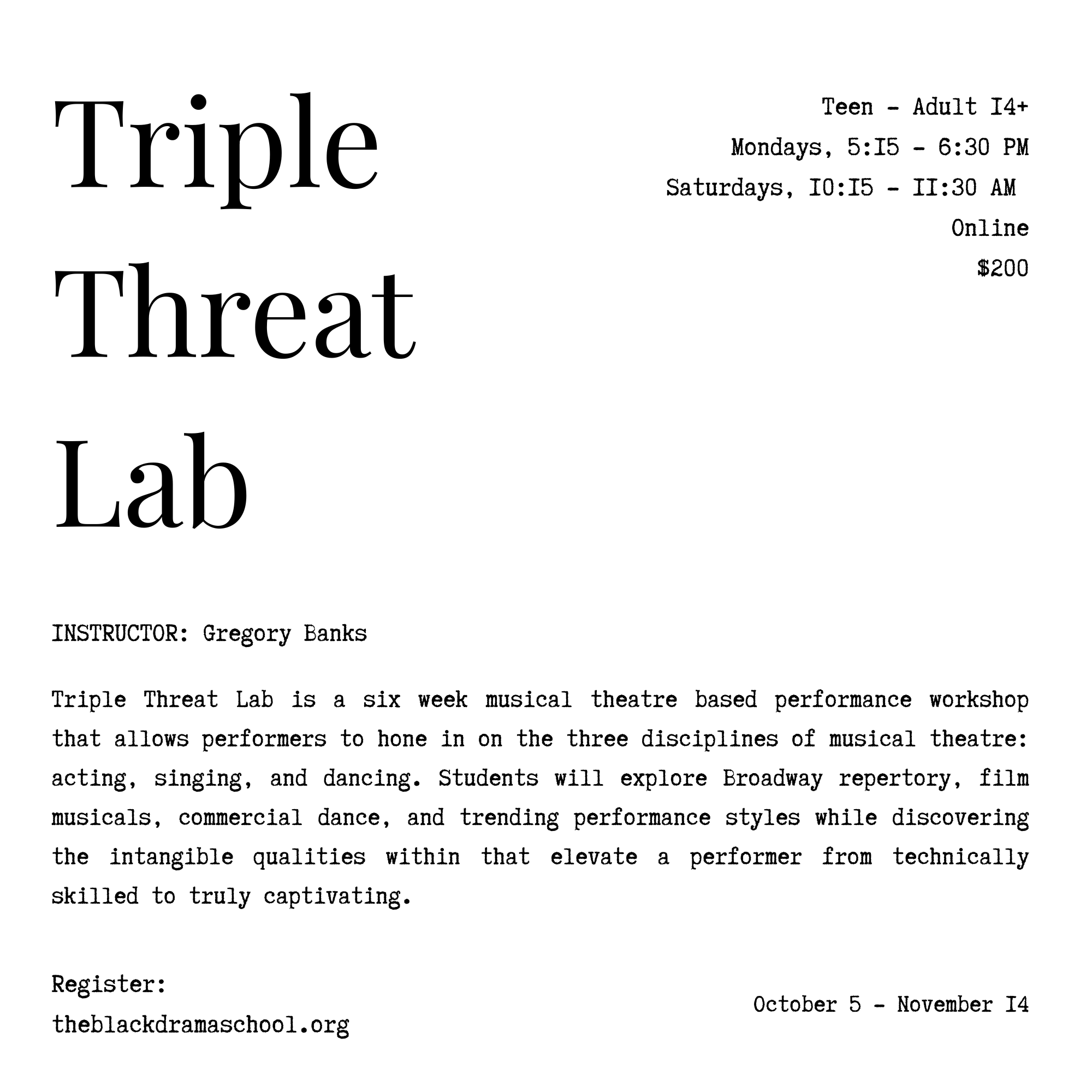
GCBJ: Um, other than the Triple Threat Lab, um... I I really, I guess that that is my little secret tidbit. I made it to finals for Todrick Hall's new musical Midnight to be his understudy. Um, yeah, I hope that our next talk is me saying that that is what I'm doing, and that I need to lock in the schedule so that we make sure that I can be at rehearsal and that I can do these classes and everything is in a time schedule and everything. I don't have anything, um, secretly brewing, no music, no music videos or anything like that. But, um, if I am able to be on this off Broadway production, you will be the 1st to know that Gregory Banks will be making their off Broadway debut.
KAJ: Oh, I cannot wait. So I guess to wrap up our last couple of questions, um, what do you want your students to know before they join you in class?
“You're already talented. That's half the battle. Now it's honing that. Now it's honing your own strength and making sure that you walk into a room, and the minute you walk into the room, that's everyone's ticket to your show.”
GCBJ: I want my students to know that there's no wrong answer. There is no limit. I want them to know that... they are capable. I want them to know that... they are the only person that can tell them no. Um, yesterday at the audition, I... [at] the audition, I felt like Aunt Viv. I had been in for the principles all week, and then yesterday they threw me for a loop and was like, hey, um, we want you to do this ensemble dance call, which that's fine by me. You know, I can do an ensemble dance call. From there, they said that they were gonna review the dance call and re-teach it in the room. Um, when we got to the room, they Aunt Viv’ed us. That girl got in front of us and said, a 5, 6, 7, 8, 12, 3, 4, 5, 6, 7, 8. And there was no review, no nothing. And I had to tap into that and tell myself, “I'm capable”. There's no wrong answer. This is a test, and I will pass the test. What happens when an understudy has to go on with no rehearsal? What happens when something changes before opening night and you just gotta go? You have to perform. And so from there, I realized that that was the test, and that I was going. I wasn't going to get a C. I might have got a B plus. But from there, um, it’s that extra reminder that I'm capable. I'm a star.
I want my students to know that, you know, any room that they walk into, the people are rooting for them. You know? The people want you there. It's not this scary process of, oh, I don't know if I'm gonna be good enough. You're already talented. That's half the battle. Now it's honing that. Now it's honing your own strength and making sure that you walk into a room, and the minute you walk into the room, that's everyone's ticket to your show. And so I would love to offer that extra X factor to my students, to let them know that they are powerful. They are the ones in control, and as long as they know that, it'll showcase throughout whatever they do with their body.
Did you miss Gregory Carl Banks Jr.’s Triple Threat Lab with TBDS Online?
Sign up for our newsletter to be the first to know when it comes back.