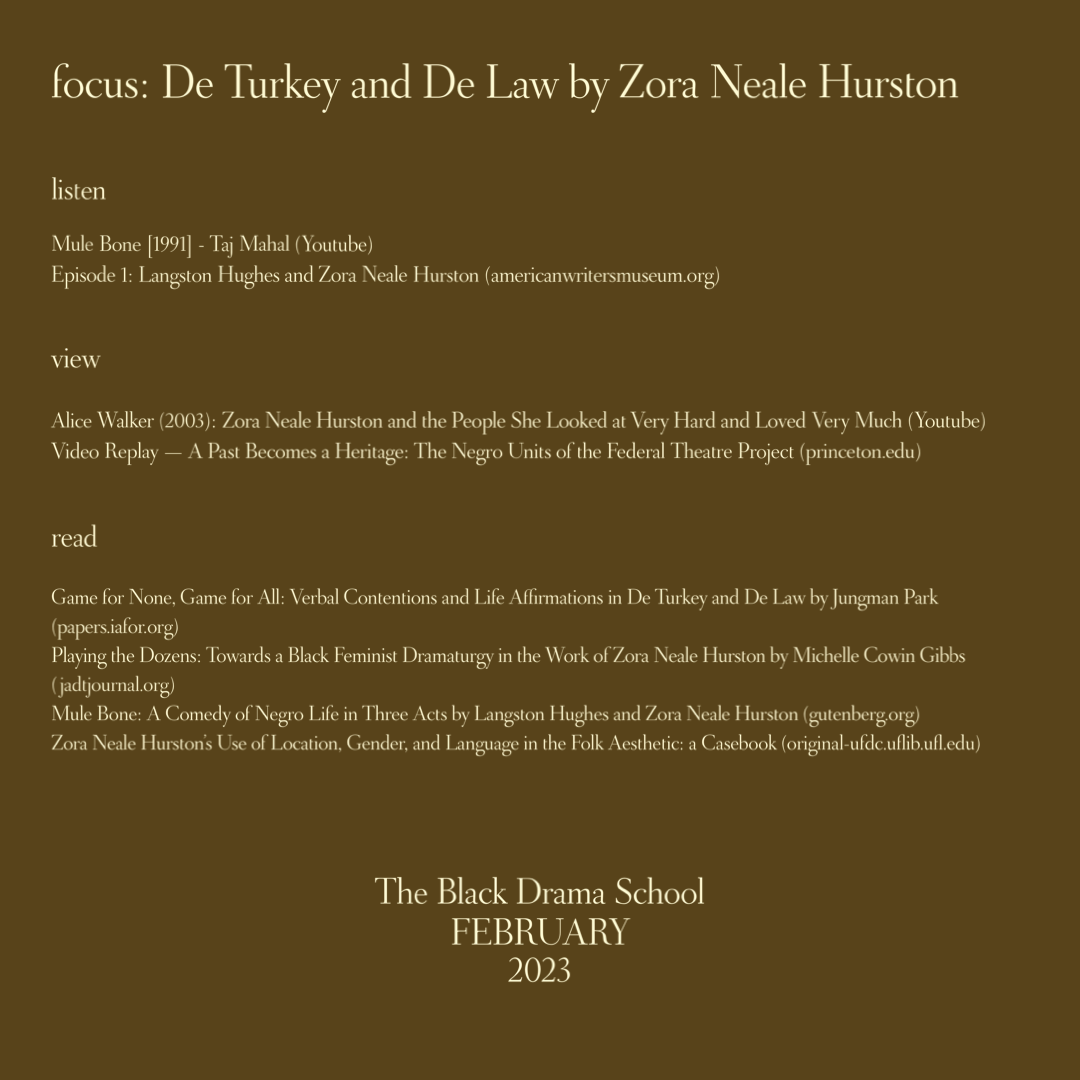
De Turkey and De Law
by Zora Neale Hurston
In the 1920s, Zora Neale Hurston and Langston Hughes decided to collaborate on a play based on Hurston’s short story ‘The Bone of Contention’ and her anthropological research in Eatonville, Florida. For a number of reasons, the play was not completed (at least not collaboratively), and two very similar folk dramas emerged— Mule Bone by Zora Neale Hurston and Langston Hughes and De Turkey and De Law by Zora Neale Hurston.
Ritual as Practice
letter writing
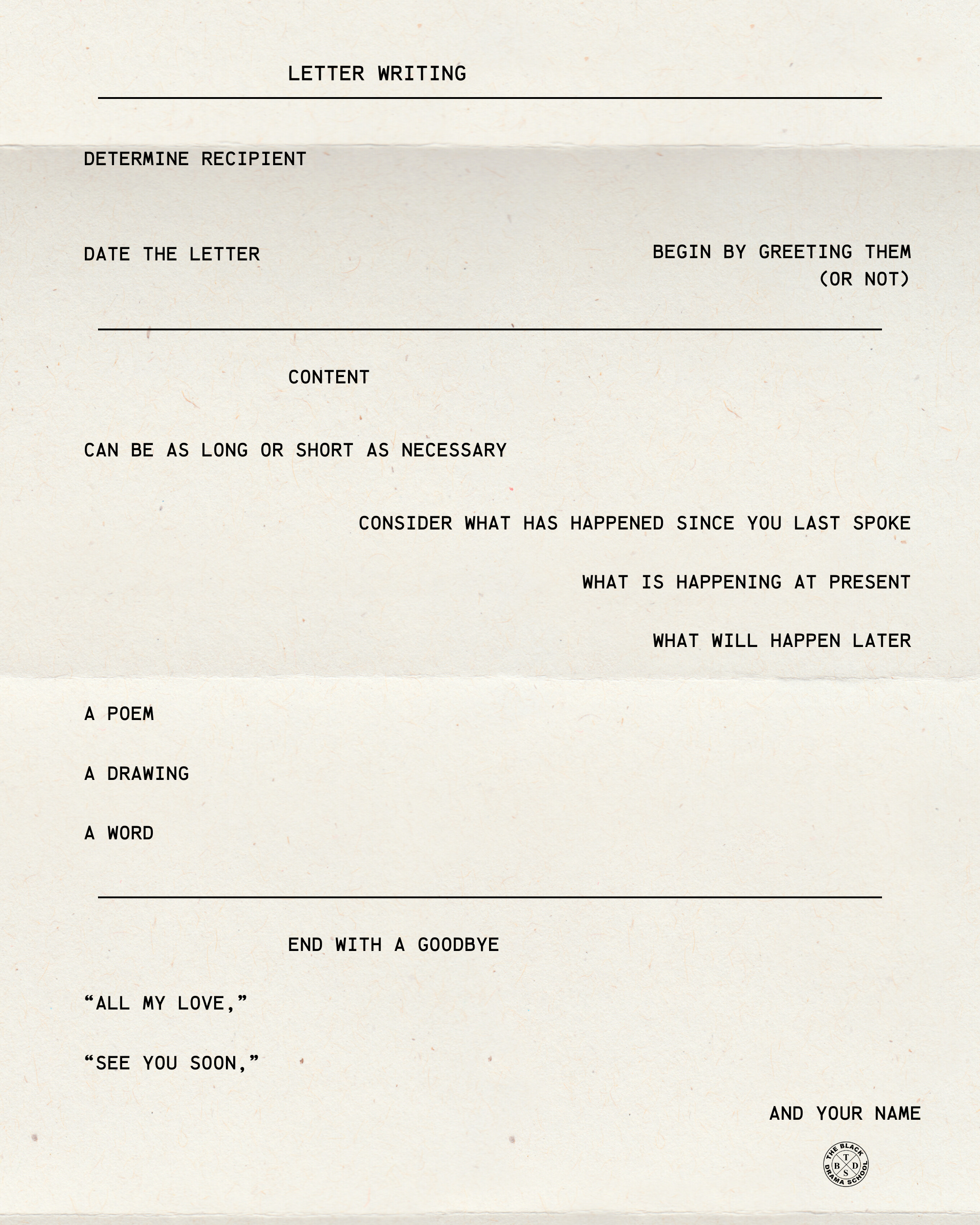
Much of what we know about the controversy surrounding Mule Bone and De Turkey and De Law comes from the correspondence between Hurston and her network of artists, scholars and philanthropists. Hurston’s letters are vital to understanding who she was and how she worked. Reading Hurston’s letters feel like reading text messages and journal entries—it’s personal.
In ‘Zora Neale Hurston: A Life in Letters’ edited by Carla Kaplan, Kaplan states that “letters allow the writer to turn toward one specific person and away from everyone else, to construct an audience that may not really exist.” (p23)
Our letter writing kit invites you to pause, construct an audience and share with intention. In your kit, you will find paper, a writing utensil, an envelope, and a how to guide based on the content and structure of Hurston’s surviving letters. Each of Hurston’s letters has a date, a determined recipient, and content that ranges in length and form.
Ritual as Practice
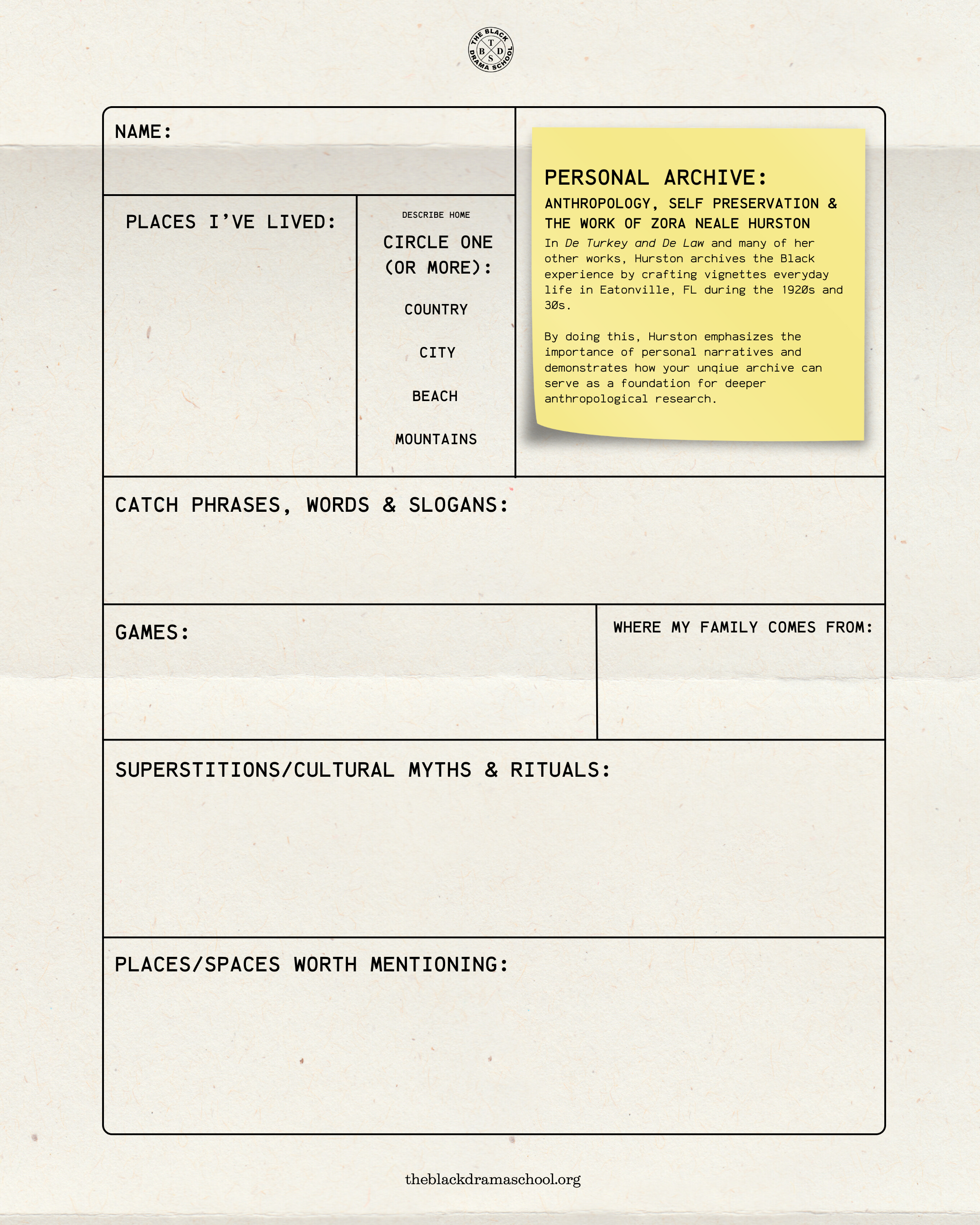
the personal archive as a foundation for research
Hurston’s work often builds upon her personal archive of experiences and memories in Eatonville. De Turkey and De Law serves as a vignette of Black life, showcasing locations, games, vernacular, cultural myths, and rituals in which the people of Eatonville engaged. Hurston takes her time painting portraits of these distinctive characteristics: the first act takes place at Joe Clark’s store, a trial is held at the Methodist church, the children play ‘chick mah chick mah craney crow,’ the men play Florida Flip and Checkers, and one of the characters reminds another “if you pull out dem eye teeth you ruins yo eyesight.”
The Personal Archive worksheet is designed to help you discover more about your foundation: who are you, where do you come from, and what is unique about that experience? How can your archive serve your academic or artistic practice?
Building upon her personal archive, Hurston’s anthropological work and writing has preserved Eatonville and it’s residents, solidifying their importance in the study of folklore. Your archive matters. This worksheet is a springboard in exploring expansive ways to record it.
Ritual as Content
‘playing the dozens,’ language, and Black vernacular
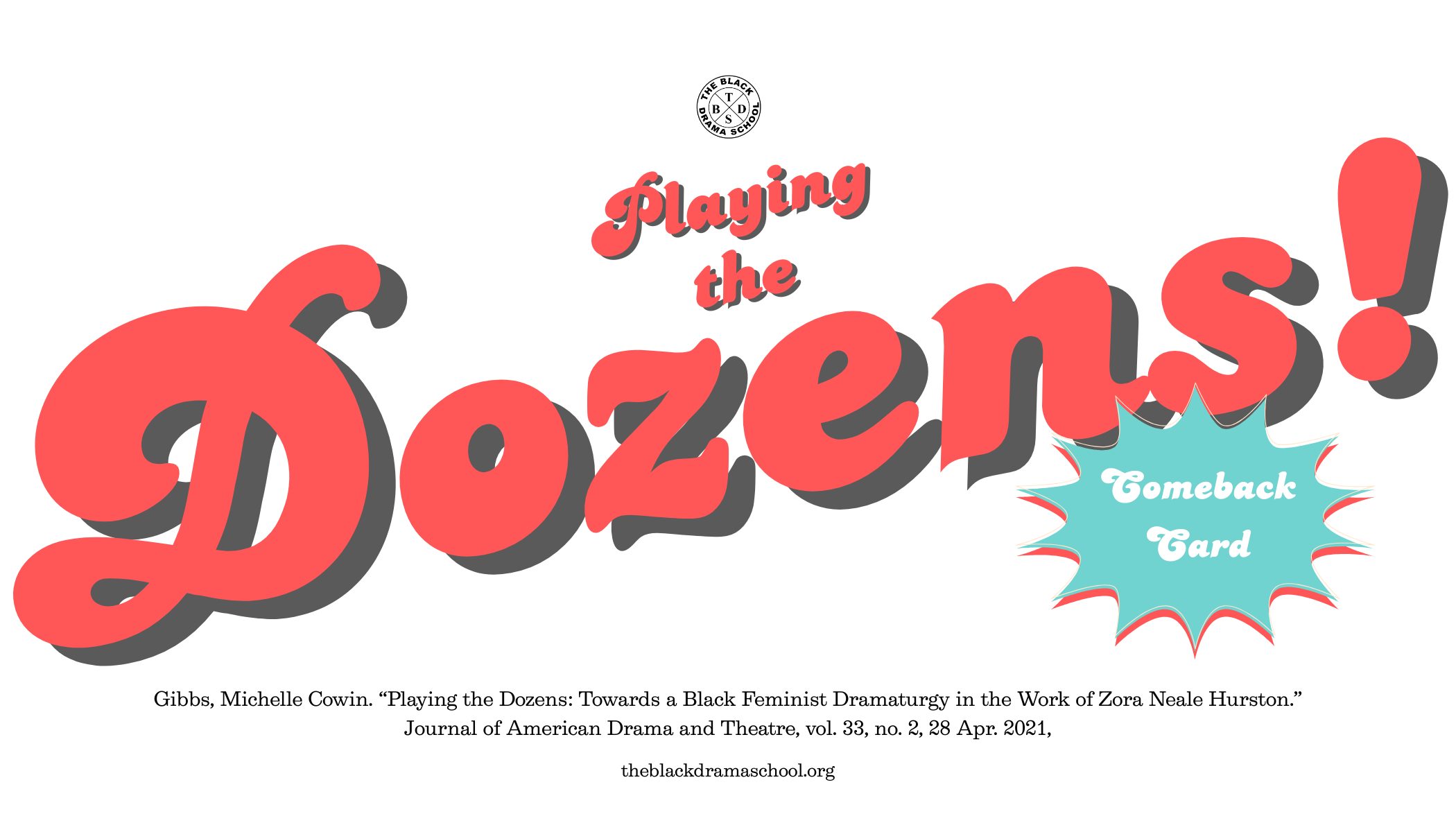
The Black vernacular tradition is a defining characteristic of Hurston’s personal archive, and the foundation on which she hoped to build a ‘real Negro art theatre.’ In ‘‘Mule Bone: A Comedy of Negro Life’ by Zora Neale Hurston and Langston Hughes and the complete story of the Mule Bone controversy,’ edited with introductions by George Houston Bass and Henry Louis Gates, Jr.; Bass asserts that in Mule Bone —and consequently, De Turkey and De Law— Hurston “draws upon the Black vernacular tradition … to “ground” [the drama] … but also to “extend” the vernacular itself.” (p20) Gates confirms this, attesting that “the play’s effect depends largely on the devices of verbal improvisation— sounding, rhyming, woofing— that are central to Afro-American folklore.” This commitment to the Black vernacular tradition can be seen most clearly in De Turkey and De Law through Hurston’s inclusion of the verbal ritual, ‘playing the dozens.’
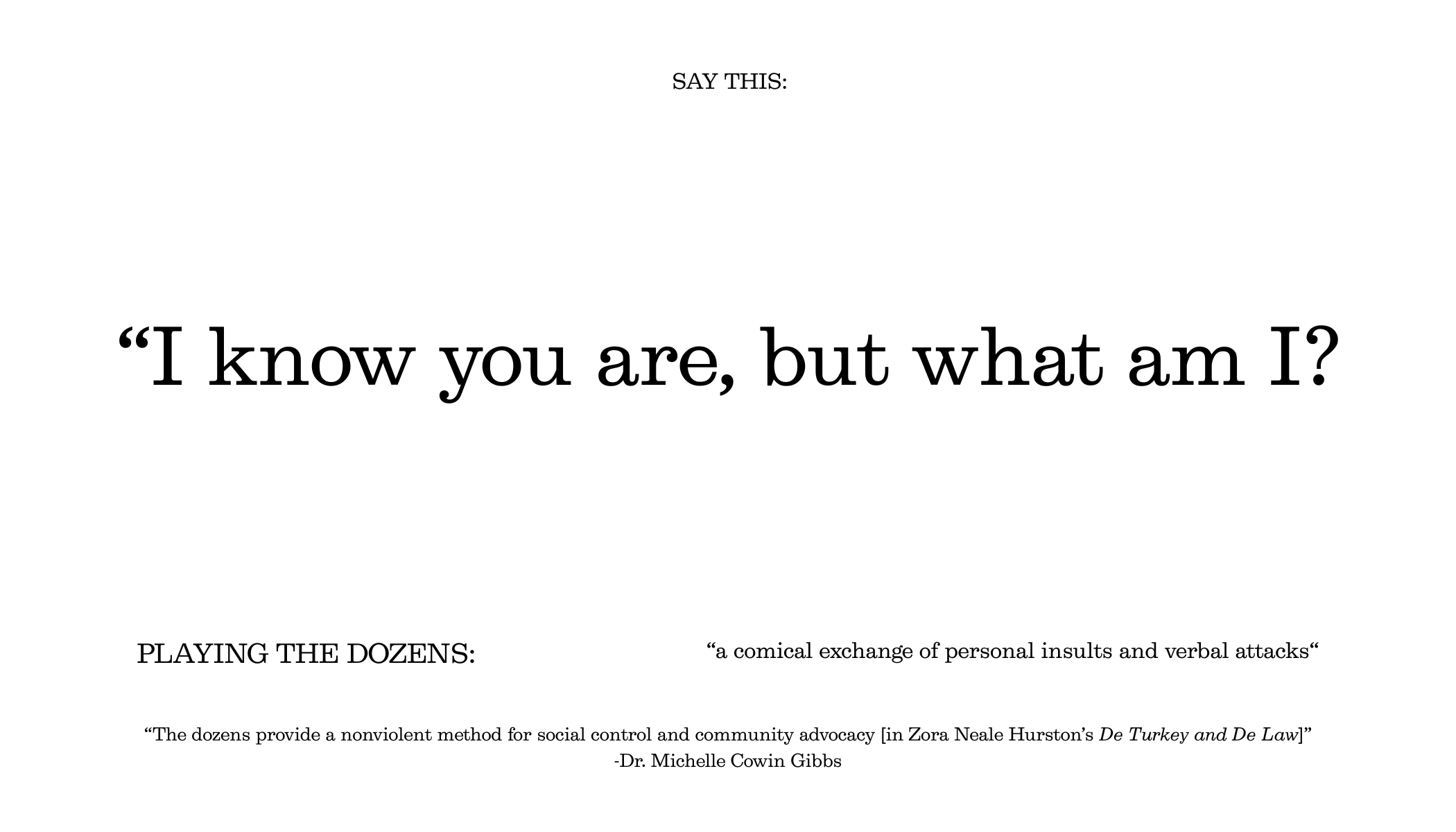
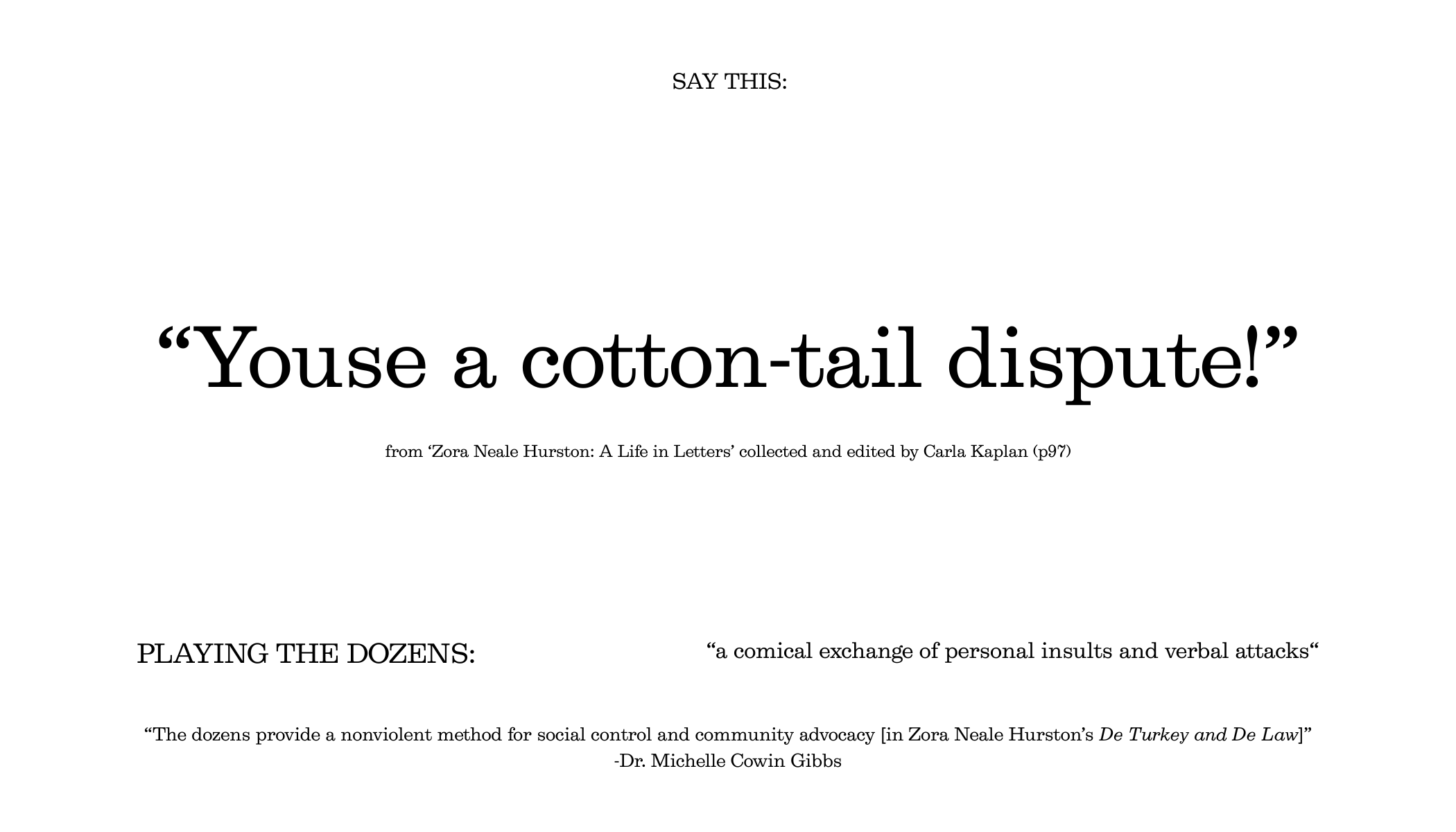
I was introduced to the term ‘playing the dozens’ through the scholarship of Dr. Michelle Cowin Gibbs. Dr. Gibbs’ essay ‘Playing the Dozens: Towards a Black Feminist Dramaturgy in the Work of Zora Neale Hurston,’ gives the beginning of Act 2 in De Turkey and De Law an anthropological context. In the essay, Dr. Gibbs describes ‘playing the dozens’ as a comical exchange of personal insults and verbal attacks that provide a nonviolent method for social control and community advocacy.
examples from the play:
Act 2 Scene 1
LINDSAY: … You know a very little of yo’ sugar sweetens my coffee. Go head on. Everytime you lift yo’ arm you smell like a nest of yellow hammers.
SISTER TAYLOR: Go ahead on yo’ self. Yo’ head look like it done wore out three bodies— talking bout me smelling— you smell lak a nest of grand daddies yo’self.
Act 2 Scene 2
SISTER LEWIS: Whut you gazin at me for? Wid your pop-eyes looking like skirt ginny-nuts.
SISTER TAYLOR: I hate to tell you whut yo’ mouf looks like. I sho do. You and soap and soap and water musta had some words.
SISTER LEWIS: Talkin’ bout other folks being dirty— yo’ young ‘uns must be sleep in they draws cause you kin smell ‘em a mile down de road.
I admire those who are quick enough to play the dozens— sometimes I think of what I could have or should have said hours later. Comeback Cards are for people who, like me, enjoy being prepared. You each have three Comeback Cards: one featuring a quote from Hurston’s research in Eatonville, one from my personal archive, and a blank one for you to write your own. The Comeback Cards are pocket sized and meant to travel with you, so you are never without something slick to say.
Comeback Cards are also a way to get the Black vernacular tradition off the page and into the mouth. In the ‘Every Tongue Got to Confess’ Reading by Ossie Davis and Ruby Dee featured on the syllabus, Hurston’s writing is described as imitating the human voice in a way that is similar to jazz music. Hurston’s work is meant to be read aloud.
Though Hurston’s vibrant and audacious nature may have obstructed a premiere of Mule Bone or De Turkey and De Law in her lifetime, it is that same nature that has made it possible for us to have her version of the story today— submitted to the Library of Congress for copyright without the knowledge of her (former) collaborator, Hughes, and eventually found hidden in a storage room seventy years later. Hurston’s personality is the lens through which we should ingest her work: she was nobody’s darling, and she was more than qualified to live among her dead.
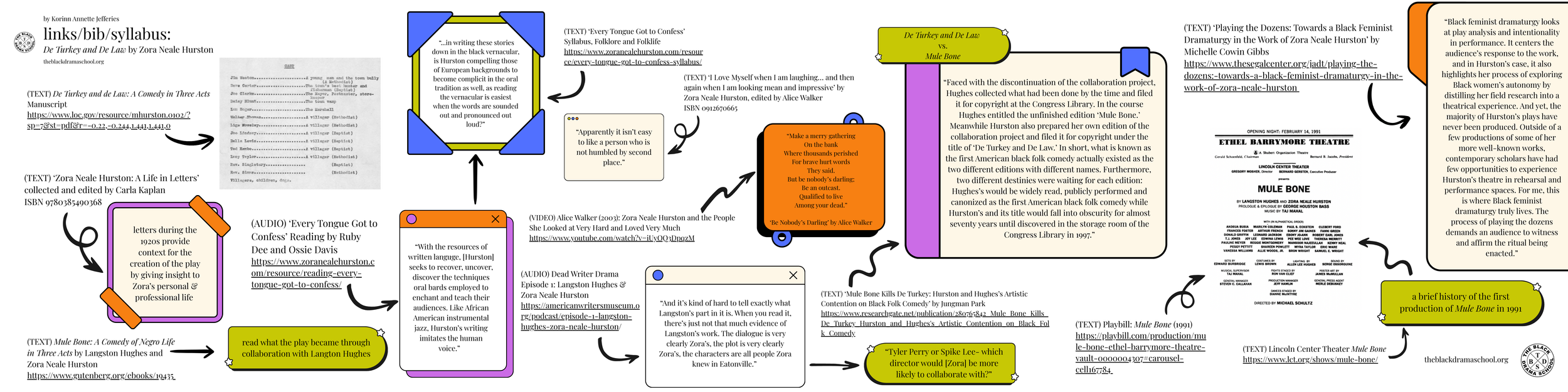
the OG syllabus
c. 2023